 AI Chatbots
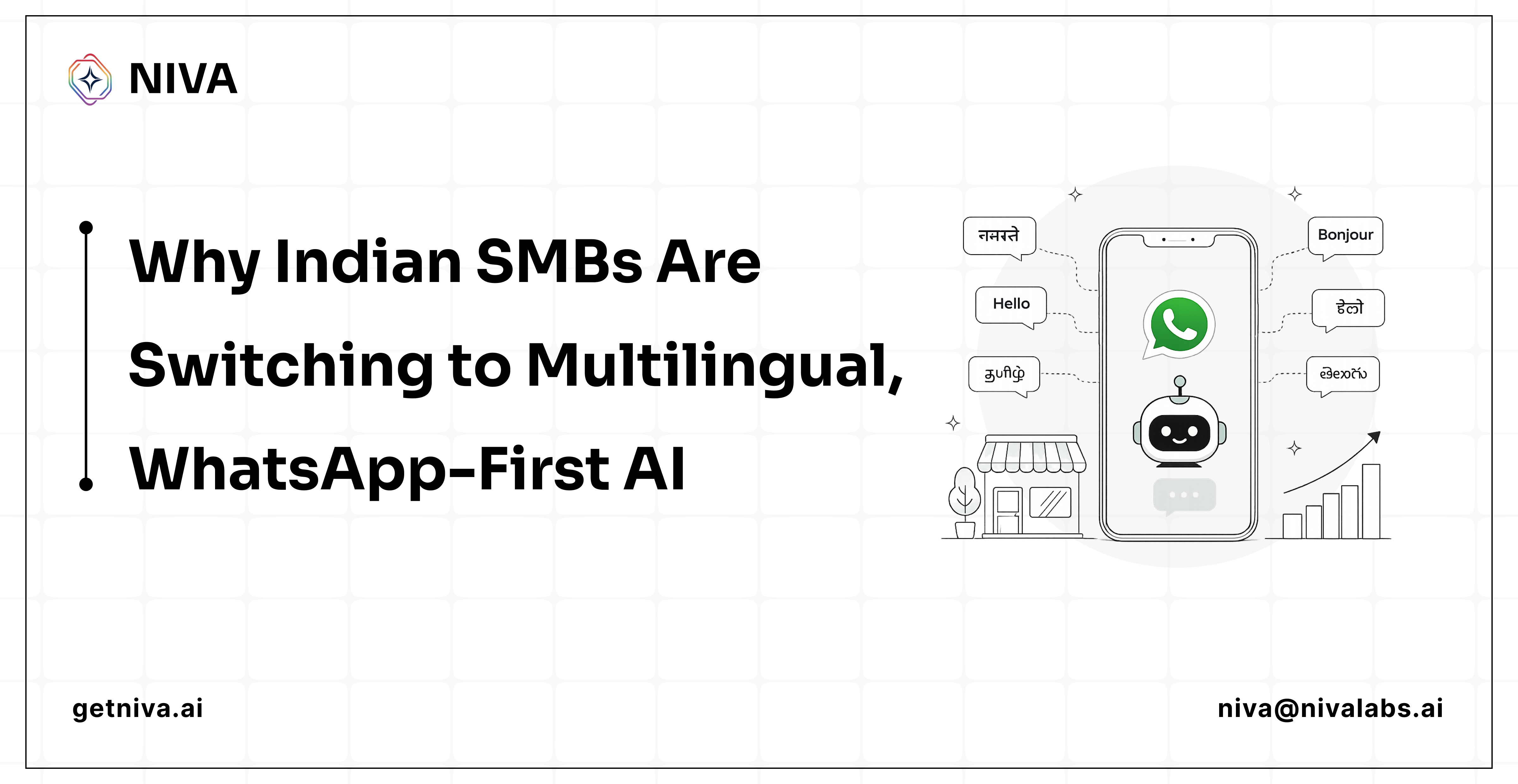
Why Indian SMBs Are Switching to Multilingual, WhatsApp-First AI
Aug 19, 20263min
We design and ship agents that understand context, call your systems, and complete multi-step work with human oversight where it matters.
Built for operations teams that need reliability, auditability, and a clear path from pilot to production.
We treat agents as operational software: scoped tools, measurable outcomes, and clear ownership after launch.
An AI agent plans steps, uses your systems, and completes tasks with guardrails. It is not a chatbot that only answers questions. It is software that moves work forward inside the tools your teams already run.
We start from the workflow: who owns the job, which systems hold truth, where judgment is required, and how success will be measured. That keeps the build grounded and reduces the risk of a demo that never reaches production.
Clear boundaries save time. Here is when this service is a strong match.
Practical building blocks for agents that operate inside your workflows, not beside them.
Agents plan and complete work across tools, with clear stop conditions and operator visibility.
Connect to CRMs, ERPs, ticketing, and internal APIs so the agent can read and write where work lives.
Ground actions in policies, history, and live system state instead of one-off prompts.
Route exceptions, high-risk actions, and edge cases to the right person with an audit trail.
Track accuracy, latency, failure modes, and operator feedback after go-live.
Respect roles, secrets, and data boundaries already defined in your environment.
A clear architecture keeps agents reliable as tools, policies, and traffic grow.
Each layer has an owner, a failure mode, and a way to observe it in production.
Ingest messages, documents, and system state so the agent knows what is happening now.
Choose steps, call APIs, and keep actions bounded by policy and permissions.
Use short-term task state and approved knowledge so behavior stays consistent.
Log decisions, surface exceptions, and keep humans able to intervene.
Common starting points with outcomes operators can recognize.
Read incoming requests, gather context from systems, draft or apply updates, and escalate when confidence is low.
Faster response with fewer manual lookups.
Check status across platforms, notify stakeholders, and open exceptions when SLAs are at risk.
Fewer status meetings, clearer exception queues.
Answer and act within approved policies for HR, finance, or compliance workflows.
Consistent handling without removing ownership.
Collect fields from email, portals, and APIs, then write structured results into the system of record.
Less swivel-chair work for analysts and coordinators.
From workflow map to a system your team can run.
Identify owners, systems, inputs, and where judgment is required.
Define tools, policies, escalation rules, and success criteria.
Implement against real data and measure quality with operators.
Deploy with monitoring, runbooks, and a path for ongoing improvement.
We align on outcomes before build starts.
Measurable reduction in cycle time or manual touches
Exception queues that operators trust
Audit trails for actions taken by the agent
Documentation and monitoring for day-two ownership
Straight answers about scope, delivery, and what working with us looks like.
A chatbot mainly answers. An agent plans steps, uses tools, updates systems, and completes work with clear guardrails and human review when needed.
Yes. We design agents to work with your APIs, identity model, and data sources so you do not have to replace operational platforms.
Focused pilots often land in weeks. Production systems depend on integrations, data readiness, and review requirements. We scope that clearly up front.
You do. We provide documentation, monitoring hooks, and optional support so your team can operate and extend the agent.
Share the workflow, systems, and constraints. We will tell you what is realistic to pilot first.
Many programs combine more than one service.
Practical notes on agents, LLM applications, and automation from production work.
Explore
Where we apply this work for specific teams and industries.