Why Indian SMBs Are Switching to Multilingual, WhatsApp-First AI
August 19, 20263min
See how NIVA helps Indian small businesses win more customers with multilingual WhatsApp AI that handles Hinglish, regional languages, leads, bookings, and orders 24/7.
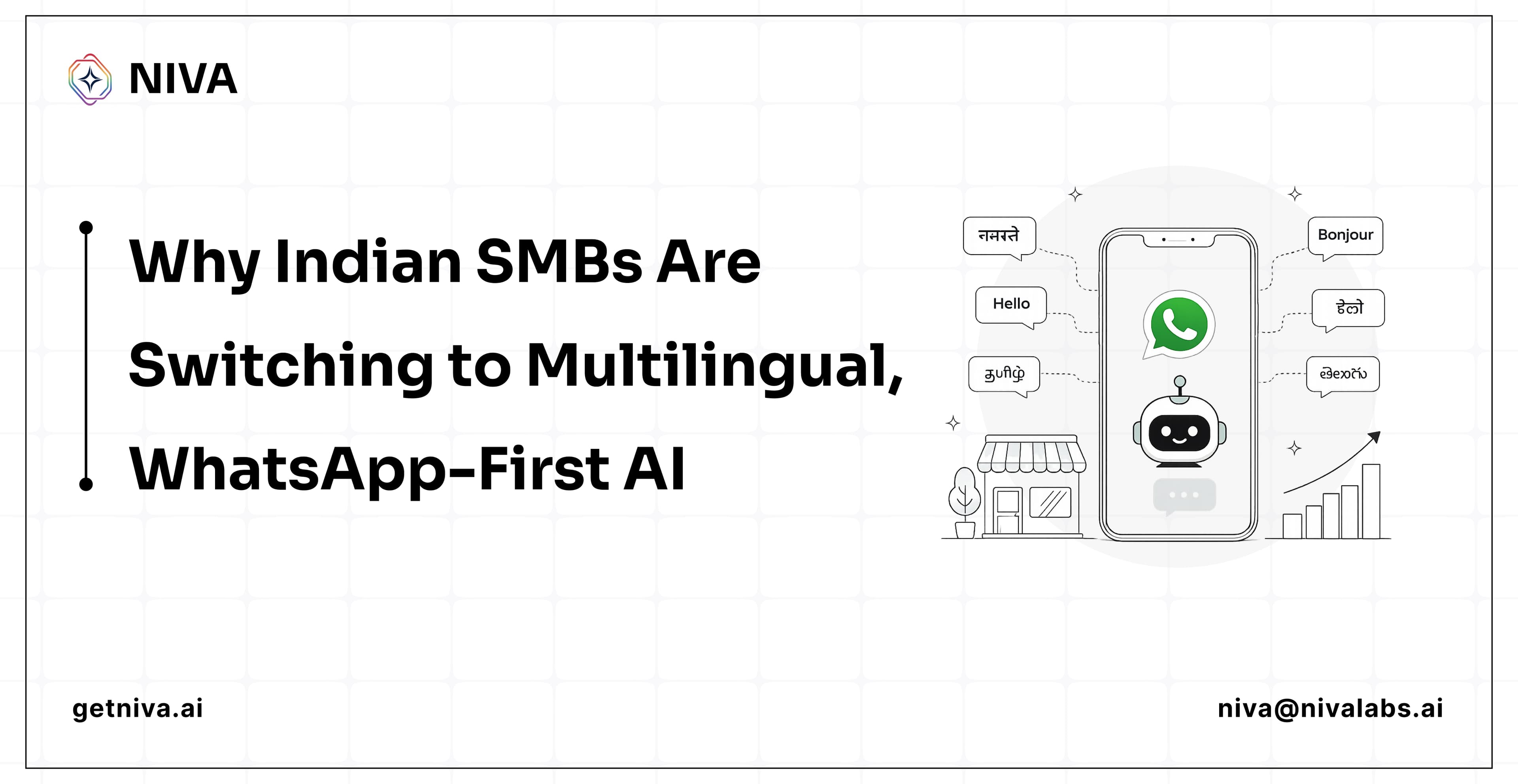
A saree boutique owner in Surat gets a message at nine at night. "Do you have this in blue, also what's COD charge, aur size chart bhi bhejo." Three questions, two languages, one sentence, and a customer who is going to buy from whoever replies first.
That message is not unusual. It is Tuesday.
The customer is already on WhatsApp, the business usually is not ready for it
Most small business owners in India did not choose WhatsApp as their storefront. Their customers did, and the business followed because that is where the conversation was already happening. Widely cited industry estimates put the share of Indian SMBs already running a WhatsApp Business account well above three quarters, and the pattern behind that number is simple. Customers do not want to download an app, create an account, or fill a contact form. They want to type a question into the same chat window they already use for everything else in their day.
The trouble is that most of these WhatsApp conversations are still being handled by one exhausted person, or by a generic chatbot that was clearly built for a different kind of customer.
The part most chatbot tools quietly get wrong
A lot of AI chatbot platforms were designed with a single, tidy, English speaking customer in mind. Ask them one clean question in English and they answer it fine. Ask them what an actual Indian customer asks, which is three questions stacked into one message, half in Hindi or Tamil or Bengali and half in English, spelled the way people actually type when they are in a hurry, and the wheels start to wobble.
This is not a small edge case. It is the normal shape of a real conversation in most Indian markets. A customer might open with "namaste," ask about pricing in English, confirm a delivery date in Hinglish, and close with a thank you in their own language, all in the same thread. A chatbot that only handles clean, single language input either misunderstands half of what is being said or forces the business owner to jump back in and finish the conversation by hand, which defeats the entire point of having a chatbot in the first place.
Small businesses do not have a support team standing by to catch what the bot misses. Every dropped message is a customer who quietly moves on to a competitor who replied faster.
What actually changes with NIVA
NIVA treats this as the normal case, not an exception. Conversations are understood and answered in whichever language the customer actually uses, including the mid conversation switching that is so common in real WhatsApp chats, so customers are not required to think in English to get a proper answer.
The business also lives where its customers already are. Instead of trying to pull people onto a separate app or a website form, NIVA connects directly through WhatsApp, so replies happen inside the same chat thread the customer already opened, day or night. If a business also gets enquiries through Instagram, web chat, or other channels, those can run through the same setup rather than becoming separate tools to manage, which is exactly the kind of scattered, always-on workload this WhatsApp and omnichannel use case is built around.
This is not a generic assistant that happens to also handle Hindi. NIVA ships with over 250 pre built industry personas, so a boutique, a clinic, a restaurant, or a real estate agent is not starting from a blank slate. The assistant already understands the kind of questions their specific business gets asked every day, whether that is retail and ecommerce, restaurants, or real estate. And when a conversation needs to turn into something real, like booking a table, confirming a size and address, or capturing a lead properly, the no-code Flow Engine and Smart Form Engine carry it through to a finished action instead of leaving the customer with an answer and no next step.
For a business fielding genuinely mixed language traffic across regions, multilingual support built for the way people actually talk stops being a nice extra and becomes the entire reason the chatbot works at all.
Why this matters to a small business owner specifically
If you are the one currently replying to WhatsApp messages between everything else you do all day, here is what actually shifts:
- No more late night replies. Questions get answered the moment they arrive, in whichever language the customer used.
- No lost customers to language gaps. Hindi, English, Hinglish, and regional switching are handled as the normal case, not a failure mode.
- One thread, not five tools. WhatsApp and other channels flow into the same setup instead of scattering conversations everywhere.
- Industry ready from day one. 250+ personas mean the assistant already understands your kind of business.
- Conversations that finish the job. Bookings, orders, and lead capture happen inside the chat, not as a follow up task for you.
If you want to see how chatbot costs actually stack up before picking a platform, this 2026 breakdown is a fair place to start.
The real shift happening right now
This is not really a story about chatbots getting smarter. It is a story about small businesses finally getting a tool that meets customers on the app they already trust, in the language they already speak, instead of asking the customer to adjust to the software.
The businesses making the switch are not chasing a trend. They are simply tired of losing a sale because a reply came an hour too late, in the wrong language, at eleven at night.
Curious what a WhatsApp-first, multilingual setup would look like for your own business? NIVA meets your customers in their language, on the app they already use. See how it fits your business at getniva.ai.
Building something similar for your operations? We can help scope the right system.