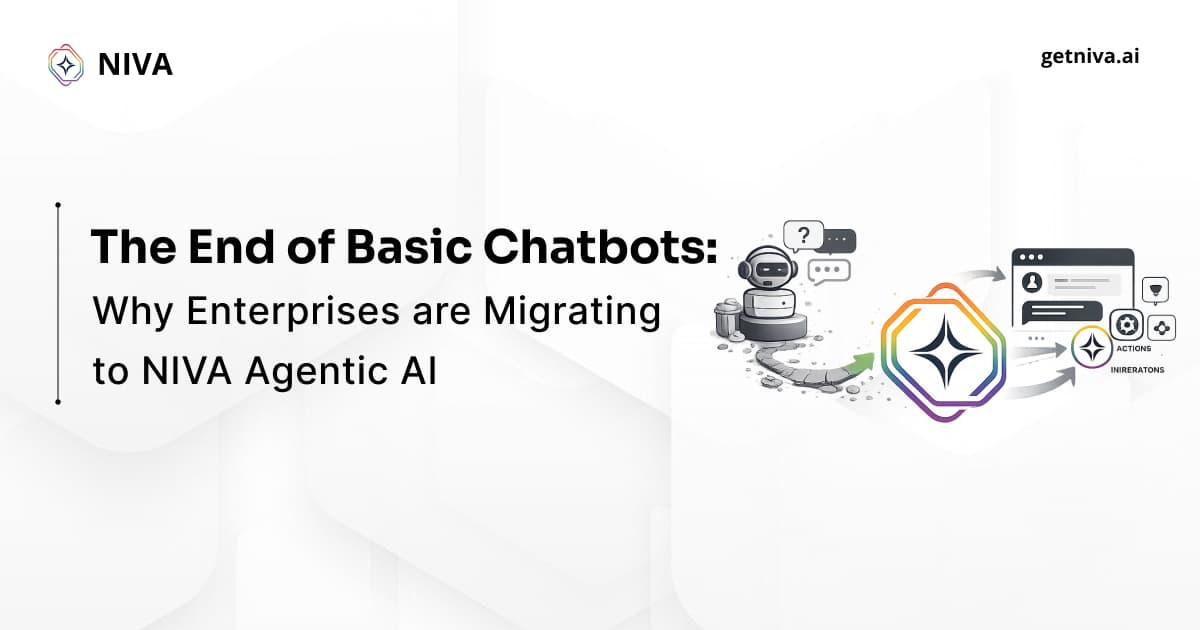
The End of Basic Chatbots: Why Enterprises are Migrating to NIVA Agentic AI
June 26, 20263min
Enterprises are ditching basic chatbots for NIVA Agentic AI. Discover why traditional bots fail to deliver real outcomes and how NIVA AI Chabot transforms customer interactions.
Something quietly shifted in how enterprises think about chatbots. It is not a trend. It is a reckoning.
For years, deploying a chatbot was treated as progress.
It handled volume. It answered FAQs at 2am. It kept human agents focused on harder problems. Leadership would look at the deflection numbers, nod approvingly, and everyone moved on.
But somewhere along the way, enterprises started asking a different question. Not "how many tickets did it deflect?" but "what did it actually accomplish?" And that question, once asked honestly, changed everything.
The answer, in most cases, was uncomfortable. The chatbot handled a layer of surface-level queries. The real work, the workflows, the follow-ups, the outcomes that customers actually cared about, still required a human to finish.
That gap is why enterprises are now moving away from basic chatbots. And it is exactly why NIVA agentic AI was built.
The Chatbot That Got Too Good at the Wrong Thing
There is a version of chatbot success that looks impressive on paper and falls apart in the real world.
High CSAT scores on FAQ interactions. Strong containment rates. Decent response times. All of it is measurable. None of it tells you whether the underlying business process moved forward.
A customer asks about rescheduling a delivery. The chatbot explains how to reschedule. The customer still has to click through four screens and find the right form on their own. Did that conversation succeed? Technically yes. Practically, the customer did everything themselves, the chatbot just told them where to go.
This is the trap that basic chatbot platforms built over years. They optimized for the conversation, not the outcome. And because the conversation metrics looked good, nobody noticed the outcome metrics were barely moving.
Enterprises have noticed now. And they are not staying.
What "Basic" Really Costs at Enterprise Scale
When you run a basic chatbot across thousands of customer interactions per day, the inefficiencies do not stay small.
Every conversation that ends without completing the underlying task sends a customer somewhere else to finish what they started. That somewhere else is usually a human. Which means the support team headcount never drops the way it was supposed to. The cost savings stay in the slide deck and never quite appear in the actual budget.
There is also a customer experience cost that is harder to measure but very real. People who interact with a chatbot that gives them good information but no actual resolution walk away feeling like they did work the business should have done for them. That feeling stacks up. It becomes the reason a customer switches vendors, writes a neutral review instead of a positive one, or just quietly reduces how much they rely on you.
At scale, "good enough" chatbot experiences are quietly eroding the relationships that enterprise sales teams spent years building.
Why Agentic AI Is Not Just a Better Chatbot
The word "agentic" is getting used a lot right now, but the concept is straightforward once you strip away the jargon.
A basic chatbot responds. An agentic AI acts.
The difference sounds simple. The practical implications are enormous.
When a prospect tells NIVA they are interested in a demo, NIVA does not just say "great, here is the booking link." It collects the information needed to make the demo useful, creates the contact in the CRM, assigns it to the right person on the sales team, and sends a confirmation to the prospect, all inside a single conversation. The human team starts their morning with a qualified, documented lead, not an unread message to follow up on.
When a customer contacts NIVA about a service issue, NIVA does not just acknowledge the problem and log it. It captures the full context, creates the support ticket, assigns it based on category and urgency, notifies the right team, and tells the customer when to expect a response. The issue is in motion before the conversation window even closes.
That is not a better chatbot. That is a different category of tool entirely.
The Industries Driving the Migration
The shift away from basic chatbots is not happening evenly. Some industries are moving faster because the gap between what they have and what they need is wider.
Healthcare providers were among the first to feel the pressure. A patient asking about a procedure at 9pm is not a routine support ticket. They have anxiety, specific questions, and a genuine need to feel taken care of. Basic chatbots cannot meet that standard. NIVA's healthcare personas handle intake, answer condition-specific questions within appropriate scope, and book follow-ups in a way that makes the interaction feel like actual care.
Real estate agencies have a similar story. A buyer browsing listings on a Saturday evening is at peak decision-making energy. A basic chatbot that answers "yes, we have properties in that area" loses the moment. NIVA qualifies the buyer, surfaces relevant listings, and locks in a viewing appointment, so the agent arrives Monday with a real conversation already in progress.
Financial services firms, logistics companies, SaaS businesses, hospitality groups, all of them are running into the same ceiling. The chatbot they deployed two or three years ago was fine for what it was. What it was is no longer enough.
What the Migration Actually Looks Like
Enterprises that switch to NIVA agentic AI do not start from scratch. The migration is faster than most teams expect because NIVA is built to adapt to existing workflows, not to impose new ones.
The first thing businesses notice is how quickly the domain expertise kicks in. NIVA's 260-plus industry personas mean the AI arrives with an understanding of how conversations in that sector naturally flow. The onboarding team is not training the AI on industry fundamentals. They are configuring it for their specific setup on top of a foundation that already exists.
The second thing they notice is what stops landing in the human queue. Routine workflows that used to require a team member to pick up, follow up, or complete manually start closing on their own. The team does not disappear, they redirect. They spend time on the conversations that genuinely need human judgment because everything else is being handled.
The third thing, and this one surprises people, is how customers respond. When interactions start ending with actual resolutions rather than instructions, customer satisfaction scores move. Not because the AI is friendlier. Because customers got what they came for without having to chase it.
The Question Worth Sitting With
Here is a test worth running on your current chatbot setup.
Pick ten conversations from last week. Follow each one to its natural end. For each one, ask: did the customer leave with the thing they needed, or did they leave with information they still had to act on?
If the majority of those conversations fall in the second category, the chatbot is doing some of the work and humans are finishing the rest. That ratio is the real cost of staying with a basic platform.
Enterprises that are moving to NIVA agentic AI have already run that test. They know the ratio. And they have made the decision that it is worth fixing properly, not patching with more FAQ content.
Why This Moment Is Different
Enterprises have evaluated "next generation" chatbot platforms before. Most of those evaluations ended with the conclusion that the new platform was a marginal improvement dressed up in better marketing.
The shift to agentic AI is not marginal. It is the difference between a tool that assists customers and a system that serves them.
The businesses moving to NIVA are not chasing a trend. They are responding to a gap that has always been there and that they now have a way to close. Their customers noticed the gap first. They are catching up.
Basic chatbots had a long run. They solved a real problem in a real way, and that mattered. But the problem they were built to solve has evolved, and they have not evolved with it.
The enterprises migrating now are not abandoning what worked. They are replacing it with something that works better, for the customers they have today and the outcomes those customers actually expect.
Related reading:
- NIVA Is Disrupting the $13 Billion Chatbot Market with True Agentic Intelligence
- From Support to Automation: How NIVA Chatbots Handle End-to-End Business Workflows
- NIVA's 250+ Industry Personas: How Domain Expertise Makes AI Chatbots Truly Intelligent
NIVA is an agentic AI chatbot platform built for enterprises that want every customer conversation to end with a completed outcome. See it in action at getniva.ai.
Building something similar for your operations? We can help scope the right system.