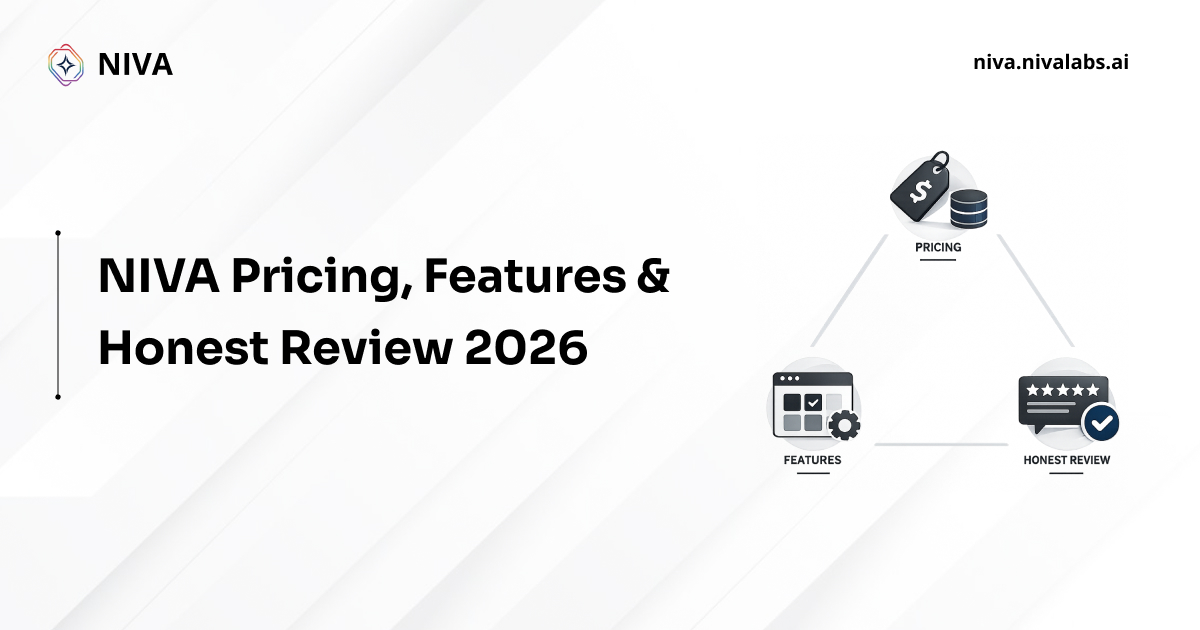
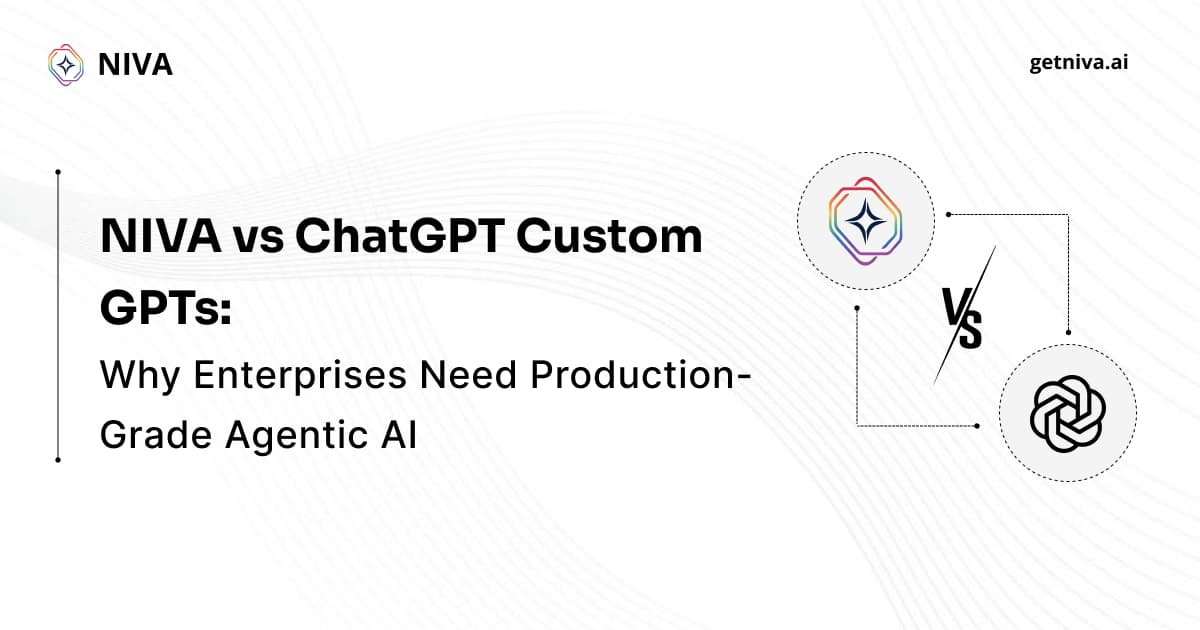
NIVA vs ChatGPT Custom GPTs: Why Enterprises Need Production-Grade Agentic AI
June 9, 20263min
NIVA vs. ChatGPT Custom GPTs: Enterprises require production-grade agentic AI for complex business operations, analytics, and real customer needs. Explore getniva.ai an Agentic Chatbot.
Most businesses start their AI journey the same way.
Someone on the team discovers ChatGPT Custom GPTs, creates a quick prototype, uploads a few documents, and within an hour, everyone is impressed.
The bot answers questions. It sounds intelligent. It feels like the future.
Then reality arrives.
Customers ask unexpected questions. Different departments need different expertise. Conversations become more complex. Teams want analytics, lead capture, workflows, memory, and business outcomes instead of just answers.
What looked like an enterprise AI solution starts revealing its limitations.
This is where many organizations discover an important distinction: there is a big difference between an AI assistant and a production-grade AI platform.
Let's explore why.
The Rise of Custom GPTs
ChatGPT Custom GPTs changed how businesses think about AI.
For the first time, creating a specialized chatbot became accessible to almost anyone. Upload documents, define instructions, and the AI can answer questions based on your information.
For internal experimentation, research, training, or personal productivity, Custom GPTs are incredibly useful.
They help teams validate ideas quickly and understand how conversational AI can fit into their business.
The challenge appears when organizations try to move from experimentation to real customer-facing operations.
That is where enterprise requirements begin to look very different.
The Enterprise Problem Most Businesses Don't See Coming
Imagine a customer visiting your website.
At first, they want product information.
A few minutes later, they ask about pricing.
Then they want onboarding guidance.
Finally, they need support for a specific issue.
In a real business, these questions are usually handled by different specialists.
A sales consultant speaks differently from a customer success manager.
A support expert has different knowledge than an onboarding specialist.
Yet most AI solutions attempt to handle every conversation through a single generalized assistant.
That approach works until conversations become nuanced.
The result is often a chatbot that knows a little about everything but lacks the depth customers expect from a true expert.
Why Generic AI Starts Feeling Generic
Customers rarely judge a chatbot based on its first answer.
They judge it after five or ten interactions.
That is when the cracks begin to show.
The conversation may lose context.
Responses may become repetitive.
Different customer types receive nearly identical answers.
The experience starts feeling less like speaking to a knowledgeable team member and more like interacting with a search box.
For businesses operating in industries with complex products, long sales cycles, or specialized knowledge, this becomes a significant challenge.
Customers expect expertise.
Not information.
There is a difference.
The Shift From Chatbots to Agentic AI
The next generation of enterprise AI is not built around a single assistant.
It is built around teams of AI specialists working together behind the scenes.
This concept is commonly known as agentic AI.
Instead of one AI trying to do everything, multiple specialists collaborate to handle different types of conversations.
Think about how successful businesses operate.
They do not hire one employee to manage sales, support, onboarding, compliance, operations, and customer success simultaneously.
They build teams.
The same principle applies to AI.
Organizations are increasingly moving toward agent-based systems because specialized expertise creates better customer experiences than a single general-purpose assistant. citeturn0academia13turn0academia12
Where NIVA Takes a Different Approach
Unlike traditional chatbot platforms, NIVA was designed around the idea that businesses need more than one AI personality.
The platform provides access to hundreds of industry-specific personas across multiple business functions, allowing organizations to create AI experiences that mirror real teams rather than a single assistant. citeturn0search0turn0search2
A visitor asking about pricing can interact with a sales-focused expert.
A customer needing onboarding assistance can receive guidance from an onboarding specialist.
A support question can be handled by an operations-focused persona.
The transition happens naturally within the same conversation, creating a seamless experience for the user. citeturn0search1turn0search0
From the customer's perspective, it feels like they are speaking with a business that truly understands their needs.
Because they are.
Custom GPTs Answer Questions. Businesses Need Outcomes.
This is perhaps the biggest difference.
Many AI tools focus primarily on generating responses.
Enterprises need something more valuable.
They need results.
A business does not invest in AI simply to answer questions.
It invests in AI to:
- Convert more leads
- Improve customer experience
- Reduce response times
- Guide customers through journeys
- Capture business opportunities
- Support teams at scale
The conversation itself is not the goal.
The outcome is.
That is why modern AI platforms are increasingly designed around customer journeys instead of isolated prompts.
Why Memory Matters More Than Most People Realize
One of the most frustrating customer experiences is repeating information.
Everyone has experienced it.
You explain your situation.
You return later.
You have to start from the beginning again.
Customers dislike it when human teams do this.
They dislike it even more when AI does it.
Production-grade AI platforms increasingly focus on maintaining context across customer interactions because continuity creates a significantly better experience. NIVA includes cross-session memory capabilities that allow conversations to continue naturally over time. citeturn0search0
The difference may sound small.
In practice, it changes how customers perceive your brand.
The Hidden Cost of Building Everything Yourself
When businesses realize the limitations of basic AI solutions, many consider building their own.
At first glance, this seems attractive.
Complete control.
Custom features.
No platform restrictions.
However, most organizations underestimate the ongoing effort required to maintain an enterprise AI experience.
The challenge is not building version one.
The challenge is to continuously improve it.
Customer expectations evolve.
Business processes change.
Knowledge bases grow.
New use cases emerge.
What begins as a chatbot project often becomes a long-term operational commitment.
This is one reason many organizations are moving toward platforms specifically designed for production deployment rather than assembling multiple disconnected tools.
What Enterprises Should Really Be Asking
When evaluating AI solutions, many businesses ask the wrong question.
They ask:
"Can this chatbot answer questions?"
Almost every modern AI platform can.
A better question is:
"Can this AI represent our expertise, support our customers, and help achieve business outcomes at scale?"
That question changes everything.
Because now the evaluation is not about chat.
It is about capability.
It is about customer experience.
It is about growth.
And it is about whether your AI feels like a tool or an extension of your team.
NIVA vs ChatGPT Custom GPTs: The Real Difference
ChatGPT Custom GPTs are excellent for experimentation, internal knowledge sharing, and quick AI prototypes.
They help organizations understand what conversational AI can do.
NIVA focuses on a different challenge.
It is built for businesses that want AI to operate as part of their customer experience, combining specialized personas, industry knowledge, memory, workflows, and business-focused interactions within a single platform.
One helps you create an AI assistant.
The other helps you build an AI-powered team.
For enterprises, that distinction becomes increasingly important as AI moves from an interesting technology experiment to a core part of customer engagement.
Final Thoughts
The AI conversation is evolving rapidly.
The question is no longer whether businesses should use AI.
Most already are.
The real question is what kind of AI experience they want to create.
A generic assistant may be enough for simple use cases.
But organizations with complex products, diverse customer journeys, and high-value relationships often need something more sophisticated.
They need AI that understands context.
AI that remembers.
AI that specializes.
AI that feels less like a chatbot and more like an experienced team working together.
That is where production-grade agentic AI begins to separate itself from basic conversational tools.
And that is exactly the direction enterprise AI is heading.
NIVA is an agentic AI chatbot platform by NivaLabs AI, the AI division of PySquad. It serves retail, ecommerce, healthcare, logistics, and 20+ other industries with pre-built AI personas, no-code flows, and full white-label customisation.
Building something similar for your operations? We can help scope the right system.