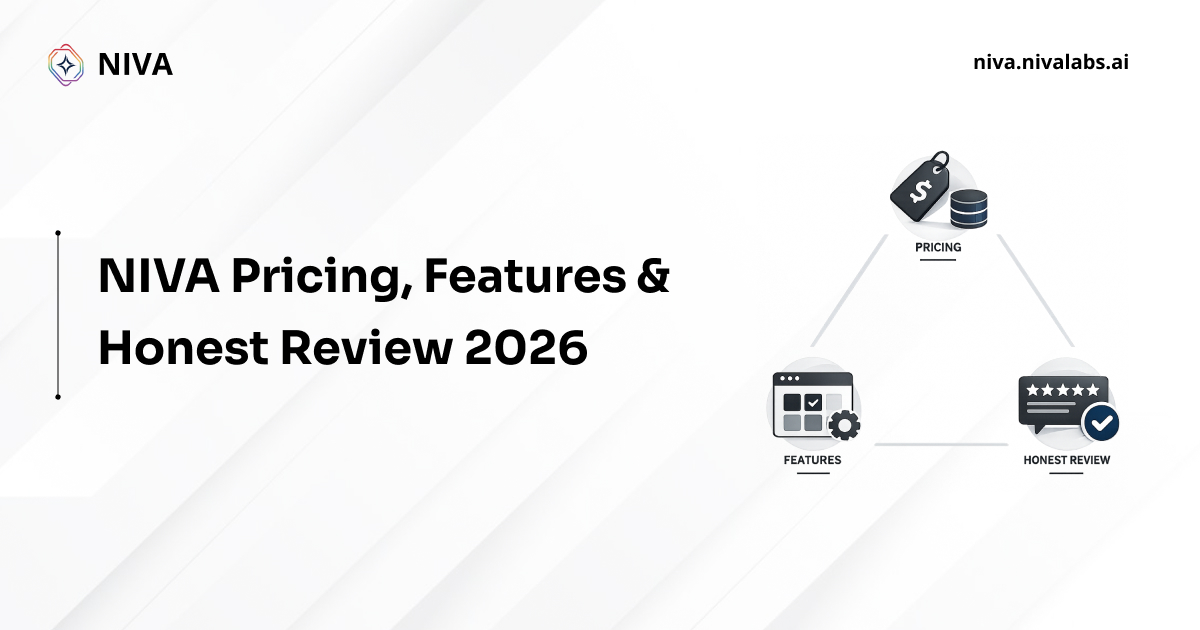
How NIVA's Cross-Session Memory and Smart Forms Deliver Real ROI for Enterprises
June 15, 20263min
NIVA's Cross-Session Memory & Smart Forms boost ROI by remembering customer interactions. Reduce sales cycles, cut support costs, and improve satisfaction. By Niva Agentic AI Chatbot.
There is a moment most enterprise customers know well.
You spend twenty minutes explaining your situation to a chatbot. It asks you the right questions, you give the right answers, and then something interrupts you, maybe a meeting, maybe a phone call, maybe just life. You close the tab and move on.
The next day you come back. The chat window is blank. The bot has no idea who you are. You start from scratch.
This is not a minor inconvenience. For enterprises dealing with thousands of customer interactions a day, this loop is a hidden leak draining revenue, customer satisfaction, and team productivity at the same time.
NIVA was built to fix this, and the results are showing up in places that matter: shorter sales cycles, lower support costs, and customers who actually come back.
Why "Starting Over" Is Costing You More Than You Think
Most AI tools on the market treat every conversation like it is the first one. Each session is a blank slate. That might work fine for simple FAQ bots, but it falls apart fast when your customers have complex needs, multi-step journeys, or questions that take more than one conversation to resolve.
Think about a B2B software company. A potential customer visits the website, asks about pricing, gets pulled into a meeting before they can book a demo, and comes back three days later. An ordinary chatbot greets them like a stranger. Your sales rep, if they had been there, would have said "Welcome back, you were asking about enterprise pricing last time, shall we pick up where we left off?"
That difference in experience is the difference between a deal that closes and one that quietly dies.
Across a single enterprise, multiply this by thousands of interactions per month. The math gets uncomfortable quickly.
What Cross-Session Memory Actually Does
Cross-session memory sounds like a technical feature, and it is, but what it actually does for a business is remarkably human.
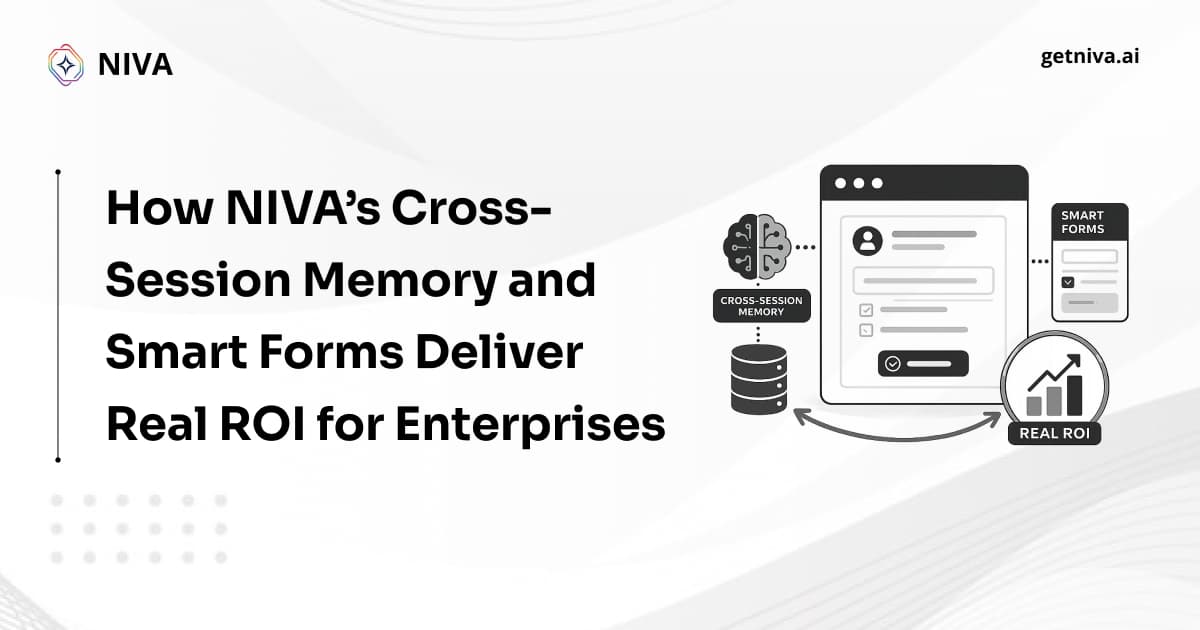
When a customer comes back to your NIVA-powered chatbot, it already knows the context from the last conversation. It knows what they asked, what they were looking for, where they dropped off. It can pick up the thread naturally, reference earlier details, and move the conversation forward instead of circling back to the beginning.
For customers, this feels like talking to someone who was paying attention. That feeling builds trust faster than any marketing copy can.
For enterprises, it means shorter paths to conversion. Instead of a customer needing three or four sessions to gather enough confidence to move forward, they can get there in one or two. That compression in the customer journey has a direct impact on close rates and support resolution times.
It also reduces load on your human teams. When a live agent eventually gets involved, they are not starting cold either. The conversation history is there. They can see what the customer has already asked, what answers they received, and what still needs to be resolved. No more "can you explain your issue again" moments that frustrate customers and slow teams down.
The Problem With Forms No One Wants to Fill Out
Forms are the other side of this equation.
Every enterprise website has them. Contact forms, demo request forms, quote request forms, support intake forms. And every enterprise knows the dirty secret: most people do not fill them out. They look at the fields, feel the friction, and leave.
The ones who do fill them out often do not get followed up with fast enough. The lead cools. The urgency fades. By the time someone reaches out, the customer has already talked to a competitor.
The traditional solution was to make forms shorter. Remove fields, make fewer things required. That helps a little, but it also means you collect less of the information you actually need, which creates more back-and-forth later anyway.
NIVA takes a completely different approach.
Forms That Feel Like Conversations
Instead of sending someone to a static form page, NIVA's smart forms appear right inside the chat window at exactly the right moment.
When a customer's conversation reaches a point where a form makes sense, whether they are ready to book a demo, request a quote, or report an issue, the form appears inline. They fill it out without losing the flow of the conversation. There is no new tab, no separate page, no cold handoff that breaks the connection they were just building with your brand.
What makes this more than just a design trick is what happens with the data. The information a customer shares in the conversation, their name, their company, the specific problem they described, all of it feeds into the form context. Your team receives a submission that already has the backstory, not just a name and email address and a blank "anything else to add?" box.
For sales teams, this means arriving at a demo call with actual intelligence about what the prospect cares about. For support teams, this means handling tickets with context already built in. Both translate to faster resolutions and better first impressions.
Where the ROI Shows Up
Enterprises often ask the right question: where exactly does this pay off?
The answer is not in one single dramatic number. It shows up in several places that compound over time.
Shorter sales cycles. When customers feel remembered and understood, they trust faster. Trust is the main thing slowing down B2B deals. Compress that, and deals close in fewer touchpoints.
Higher form completion rates. Inline conversational forms consistently outperform standalone form pages. The friction is lower, the context is better, and customers are already in a "responding" mindset when the form appears.
Lower support costs. When your AI handles the repetitive, context-heavy intake work, your human agents spend their time on genuinely complex cases. The cost per resolution drops. Team morale tends to go up too, since no one likes repeating themselves to frustrated customers any more than customers like being asked to repeat themselves.
Better data quality. A form filled out mid-conversation captures more nuanced, accurate information than a standalone form filled out at 9 PM after a long day. Your CRM ends up with better inputs. Your follow-up is more relevant. The downstream effects on pipeline quality are real.
Fewer dropped leads. The combination of memory and smart forms means more conversations reach a meaningful handoff point. Fewer customers ghost mid-process because the experience felt effortful or impersonal.
This Is Not About Replacing Your Team
One thing enterprises sometimes worry about when looking at AI tools: will this make our people redundant?
The answer with NIVA is straightforward. The goal is to make your team dramatically more effective at the things humans do best, listening to nuanced problems, building relationships, making judgment calls.
When your AI handles the repetitive, structured work, your people get to do more of the work they were actually hired to do. That is better for them, better for customers, and better for the business.
Cross-session memory and smart forms are not a replacement for human judgment. They are the infrastructure that makes sure human judgment gets applied at the right moments, with the right context, rather than getting swallowed up in data-gathering busywork.
What Enterprises Are Seeing in Practice
The pattern across different industries looks similar.
Companies that deploy NIVA on their customer-facing website see a measurable drop in form abandonment rates within the first few weeks. Demo request pipelines move faster. Support ticket resolution times shrink because intake is cleaner.
The feedback that keeps coming back from customers is not about the technology. It is about how it felt. "It actually remembered what I was asking about." "It felt like talking to someone who cared." "I did not have to explain myself again."
Those are the outcomes that compound. Customers who feel well-treated come back more often, refer others more readily, and are far more forgiving when something occasionally goes wrong.
The Bottom Line
Enterprises have been sold a lot of AI tools over the past few years. Most of them improved efficiency in narrow, measurable ways without actually improving the experience customers have.
Cross-session memory and smart forms work because they address something more fundamental: the feeling of being known and understood. When your website can deliver that at scale, without adding headcount, without slowing your team down, and without asking customers to repeat themselves, the ROI takes care of itself.
NIVA was built for this. Not as a chatbot that answers questions, but as an intelligent layer that makes every customer interaction feel like it was designed specifically for that person.
If you want to see how it works for your specific use case, the conversation is a good place to start.
Ready to see NIVA in action? Book a demo at getniva.ai and we will show you exactly how memory and smart forms map to your customer journey.
Building something similar for your operations? We can help scope the right system.