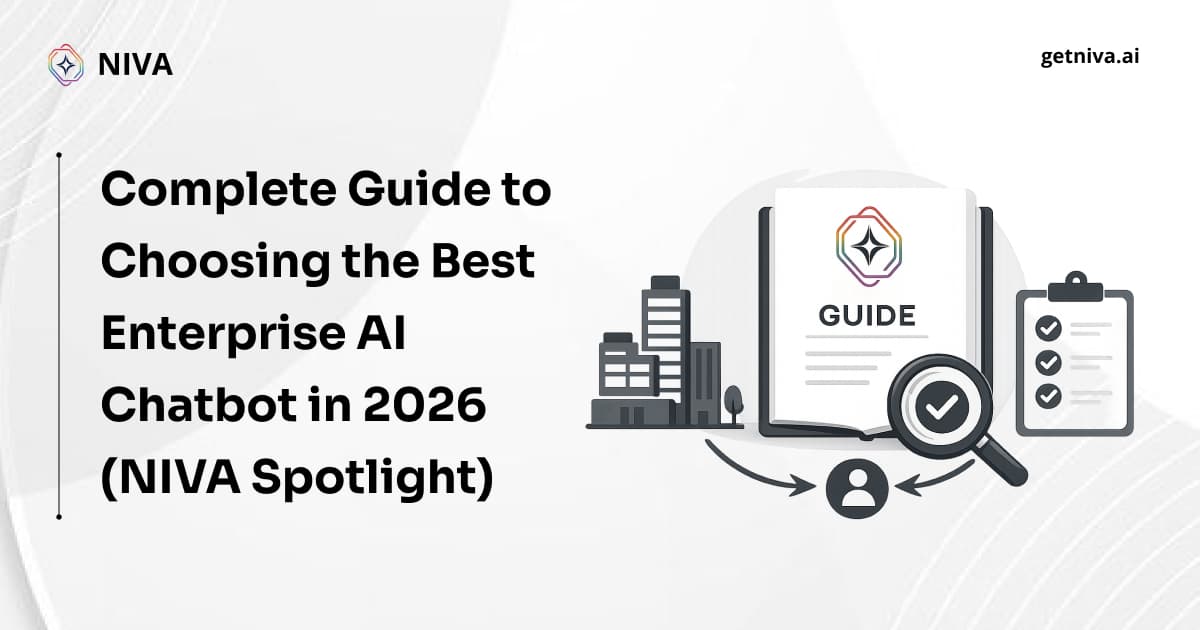
Complete Guide to Choosing the Best Enterprise AI Chatbot in 2026
June 18, 20265min
Choosing an Enterprise AI Chatbot in 2026? Get an honest, in-depth guide to cut through the hype and find the best platform for your business needs.
Let us start with something honest.
Most "buyer's guides" for enterprise software are written by the vendors themselves, dressed up as independent advice. They walk you through evaluation criteria that, coincidentally, happen to favor the product they are selling. They use phrases like "industry-leading" and "enterprise-grade" and "AI-powered" without defining any of those things.
This guide is going to try something different.
We are going to talk about what enterprise AI chatbots actually do, where most of them fall short, and what separates a platform that genuinely moves the needle from one that just looks good in a demo. Then we are going to look at NIVA specifically, not through marketing language, but through the questions a buyer should actually be asking.
If you are evaluating chatbot platforms for your business in 2026, this guide is the one to read before you book your first vendor call.
Why 2026 Is a Genuinely Different Moment
It is tempting to treat 2026 as just another year in the AI hype cycle. That would be a mistake.
The capability gap between what AI could do three years ago and what it can do today is real and substantial. Conversations that used to require a human to handle with any grace can now be managed by AI that understands context, picks up on nuance, and adapts its approach mid-conversation. That is not marketing copy. It is just what has happened.
But here is the part that matters for buyers: capability improvements do not automatically translate into business value. A smarter AI inside a poorly designed platform is still a poorly designed platform. And the proliferation of "AI-powered" everything in the market has made it genuinely harder to distinguish between products that work and products that just sound good on a website.
The businesses making smart decisions right now are not the ones rushing to deploy AI because everyone else is. They are the ones taking the time to understand what they actually need, evaluating carefully, and choosing platforms that are built for the kind of work they are trying to get done.
That is what this guide is designed to help you do.
The Eight Questions That Actually Matter
Before you evaluate a single platform, you need clarity on your own requirements. These eight questions will get you there faster than any vendor scorecard.
1. What type of interactions are you trying to handle?
Customer support, lead generation, internal helpdesk, onboarding, sales enablement. These are different problem categories with different platform requirements. A chatbot built to deflect support tickets operates on completely different assumptions than one built to qualify enterprise prospects. Know which category you are in before you start talking to vendors.
2. How complex are the conversations you need to support?
A platform that handles "what are your business hours" does not need the same AI capabilities as one handling "help me understand which pricing tier makes sense for a company of my size with these specific needs." Complexity is the single most important dimension for understanding what kind of platform you actually need.
3. What does the handoff to a human look like?
Every AI chatbot will eventually need to pass a conversation to a human. The quality of that handoff, whether the agent gets context, whether the customer has to repeat themselves, whether the urgency is preserved, tells you more about a platform than almost anything else.
4. What systems does the chatbot need to connect with?
CRM, helpdesk, calendar, email, internal databases. Most platforms will claim broad integration support. The question is how deep that integration actually goes and who is responsible for maintaining it when something breaks.
5. Do you need the chatbot to trigger processes, or just answer questions?
This is the question most buyers skip, and it is the one that tends to determine whether a deployment succeeds or becomes an expensive FAQ page. If you need a conversation to kick off an approval workflow, create a record, send a notification, or schedule something, the platform needs workflow capabilities, not just conversation capabilities.
6. Who will manage it after go-live?
This matters more than most buyers realize. If the team managing the chatbot after launch needs a developer every time something changes, the platform will get stale fast. If it can be managed by a business user without technical knowledge, it stays current.
7. How does it handle multiple languages and customer segments?
A global enterprise with customers in multiple markets cannot use a platform that only works well in English. And a business with very different customer types, think prospects versus long-term clients, needs a chatbot that can adapt its approach accordingly.
8. What does pricing look like at real scale?
The demo pricing is rarely the pricing you will pay once you are live with real volume. Understand the per-conversation costs, the tier jump thresholds, and what happens when traffic spikes during a product launch or a PR moment.
What "Agentic AI" Actually Means in 2026
The term "agentic AI" gets used loosely enough that it has almost stopped meaning anything. Here is a working definition worth holding onto.
An agentic AI does not just respond. It acts.
A response-only chatbot hears a question and gives an answer. It is reactive. It waits for the next prompt and reacts to that. The human is doing the navigating. The AI is doing the replying.
An agentic AI reads the full context of a conversation and makes decisions about what to do next without waiting to be told. It can decide whether to ask for more information, show a form, trigger a process, escalate to a human, or continue the conversation based on what it knows about the situation so far. It does not just answer. It moves things forward.
The practical difference is significant. A response-only chatbot can reduce your inbound support volume somewhat. An agentic AI can actually close interactions, which is a fundamentally different value proposition.
The catch is that not every platform calling itself "agentic" has actually built this capability. Many have layered the word over what is essentially a more sophisticated FAQ engine. The test is simple: can the chatbot make a decision about what to do next based on context, or does it just respond to what the user said most recently?
Why Most Enterprise Chatbots Fail at Scale
Here is something vendors rarely volunteer in sales conversations.
Most enterprise chatbot deployments deliver disappointing results not because the AI was bad but because the platform was not actually designed for the problem the business was trying to solve.
The pattern looks like this. A company buys a well-reviewed platform. They configure it carefully. They run a pilot that goes reasonably well. They roll it out. And then, over the next six to twelve months, one of three things usually happens.
First: the chatbot handles easy queries fine but becomes a dead end for anything complex. Customers learn to skip it and go straight to email or phone. The deflection rates look decent in the dashboard but the real high-value interactions are bypassing the system entirely.
Second: the chatbot works but the data stays inside it. There is no clean connection to the CRM, the helpdesk, the sales tools. Every insight generated in a conversation requires manual extraction. The chatbot becomes a conversation silo rather than an integrated part of how the business operates.
Third: the chatbot becomes stale within months because maintaining it requires developer involvement and developer time is always prioritized somewhere else. The knowledge base goes out of date. The flows stop reflecting current processes. Customers start getting wrong information, and the platform becomes a liability rather than an asset.
All three of these failure modes are predictable, and all three of them can be avoided with the right platform choice upfront.
Where NIVA Is Different: The Honest Breakdown
NIVA is not trying to be every chatbot platform. It was built with a specific philosophy: that conversations and the processes they kick off should live in the same system.
Here is what that means in practice.
Memory that spans sessions
Most platforms treat each conversation as isolated. NIVA maintains context across sessions. When a customer comes back after a few days, the system knows who they are, what they were asking about, and where the conversation left off. This sounds like a small thing and turns out to matter enormously in practice. Customers who feel recognized behave differently than customers who feel like strangers. They trust faster. They engage more honestly. They are more likely to reach a resolution.
Forms that live inside the conversation
Static forms on separate pages are friction. NIVA's smart forms appear directly inside the chat at the right moment, when the user is ready to provide information, not before. The form does not interrupt the conversation. It continues it. The data collected is cleaner, the completion rates are higher, and the experience for the customer is genuinely different.
A workflow engine that is not bolted on
This is the structural differentiator that is hardest to explain in a feature list and easiest to understand in practice.
Most platforms let you connect to automation tools. NIVA has workflow logic built into the same system as the conversation logic. A chatbot can collect information and immediately trigger a sequence of processes, not by calling a webhook to a separate tool but by activating workflow logic that knows the full conversation context. The result is workflows that behave intelligently based on what actually happened in the conversation, not just based on which button was clicked.
Multi-persona capability
A single chatbot powered by NIVA can present itself differently to different types of customers without manual configuration per customer. A prospect gets a different conversational approach than an existing enterprise client. A support case gets handled differently than a new product inquiry. This is not just tone-switching. It is a contextual shift in what the chatbot knows, prioritizes, and focuses on based on who it is talking to.
Escalation that actually works
When a conversation needs a human, NIVA passes full context, not just a transcript. The agent who picks up the conversation knows everything the chatbot knows. They do not ask the customer to start over. They continue from where the AI left off. That sounds like a small thing and is the kind of thing that turns frustrated customers into satisfied ones.
The Evaluation Trap: Why Features Are Not the Point
When enterprises evaluate chatbot platforms, they tend to compare feature lists. It is the natural thing to do. You build a matrix. Vendors fill in columns. You score them.
The problem with this approach is that features can be checked off without the underlying capability being meaningfully present. A platform can have "workflow automation" as a checked box while that automation is one fragile webhook away from breaking. A platform can have "AI-powered responses" as a feature while the AI is a pattern-matching engine from three years ago.
The better evaluation approach is to design tests that simulate your actual use case and watch where systems break down.
Bring your most complex, most ambiguous customer queries. The ones your support team says are the hardest to handle. Ask the chatbot those. See what it does. See what the failure mode looks like when it cannot answer well. Does it confabulate confidently, or does it route gracefully?
Ask to see the admin experience. Watch how a non-technical user updates the knowledge base, modifies a workflow, or reviews analytics. How long does it take? How much can break?
Ask what happens when traffic doubles unexpectedly. What does the platform do under load? What is the pricing implication?
Ask for a reference from a customer in a similar industry with similar volume. Not a reference the vendor pre-selected. A customer you can call and ask honest questions.
These are the questions that reveal whether a platform will work in your environment, not just in a demo environment.
How to Think About NIVA for Your Use Case
NIVA is not the right platform for every situation. Here is an honest breakdown of where it fits well and where it may not be the first choice.
NIVA is a strong fit for businesses where:
- Customers have multi-session buying journeys and context across sessions matters
- The chatbot needs to trigger workflows, not just answer questions
- Different customer types need meaningfully different conversational experiences
- The team managing the chatbot post-launch is not primarily technical
- Integration with CRM, support, or operational tools is a core requirement rather than a nice-to-have
- The business is growing and needs a platform that scales without renegotiating pricing structures
NIVA may not be the first choice if:
- The use case is strictly internal IT helpdesk with a fixed, stable knowledge base
- The deployment is a temporary or experimental pilot with very limited scope
- The team has significant existing investment in a specific chatbot ecosystem and switching costs are very high
The honest self-assessment matters here. Choosing a platform that is a genuine fit for your use case will always outperform choosing the most impressive-sounding option.
Before You Book That Demo
A few things worth doing before your first conversation with any vendor, including NIVA.
Write down the three most expensive problems your current customer interaction approach has. Not vague frustrations. Quantifiable costs. Support tickets that take too long. Leads that go cold. Workflows that require manual steps. Having those numbers in front of you keeps the conversation grounded.
Decide who will own the chatbot post-launch. Name them. Include them in the evaluation. The best platform for your organization is partly a function of what your internal team can realistically manage.
Run the demo on your use case, not the vendor's use case. Ask them to demonstrate their platform solving your specific problem, with your specific inputs. Vendors who hedge on this are often hedging for a reason.
And read the contract carefully before signing. Specifically the pricing tiers, the data ownership clauses, and the terms around exporting your data if you ever need to switch.
The Bottom Line for 2026
The enterprise AI chatbot market in 2026 has genuinely capable options. The vendors who survived the last two years of competitive pressure are mostly building real products now, not just demo-ware.
The challenge for buyers is cutting through the noise to find the platform that fits the actual work, not just the pitch.
NIVA was built around the premise that conversation and process should live together, that customers should feel recognized across sessions, and that the businesses deploying AI tools should be able to manage them without a developer on speed dial.
For enterprises that are serious about turning AI from a line item into a lever, that premise is worth taking seriously.
NIVA is available for enterprise deployments at getniva.ai. If you want to see how it handles your specific use case, the demo is designed to show you the platform on your terms, not a rehearsed script.
Building something similar for your operations? We can help scope the right system.